Thales
A self-sustaining floating ocean research station for scientists and visitors
00

problem
Marine research is critical, but sustained work at sea is constrained by distance, harsh conditions, and high operational cost. Most studies rely on short expeditions, limited lab access, and intermittent data collection, which makes it difficult to observe long-term ecological change in real time. At the same time, offshore research infrastructure is expensive to build and maintain, and funding is often fragile—leaving many promising projects under-resourced and disconnected from public understanding and support.
solution
Thales is a self-sustaining floating ocean research station designed for long-term scientific living and fieldwork. It combines modular labs and living quarters with renewable power generation, desalination, and closed-loop systems to reduce reliance on supply chains and enable continuous observation. To support financial sustainability and public engagement, Thales also integrates a controlled visitor program—guided tours, learning experiences, and citizen-science activities—turning the station into a platform where research, education, and funding reinforce one another.
Thales is structured as a layered offshore system, designed to separate research operations from public circulation while keeping the station functional under open-sea conditions. Above the waterline, the station organizes arrival, research, and daily living; below the waterline, a deep central core anchors the structure, houses key infrastructure, and reduces wave-driven motion through a long submerged profile.
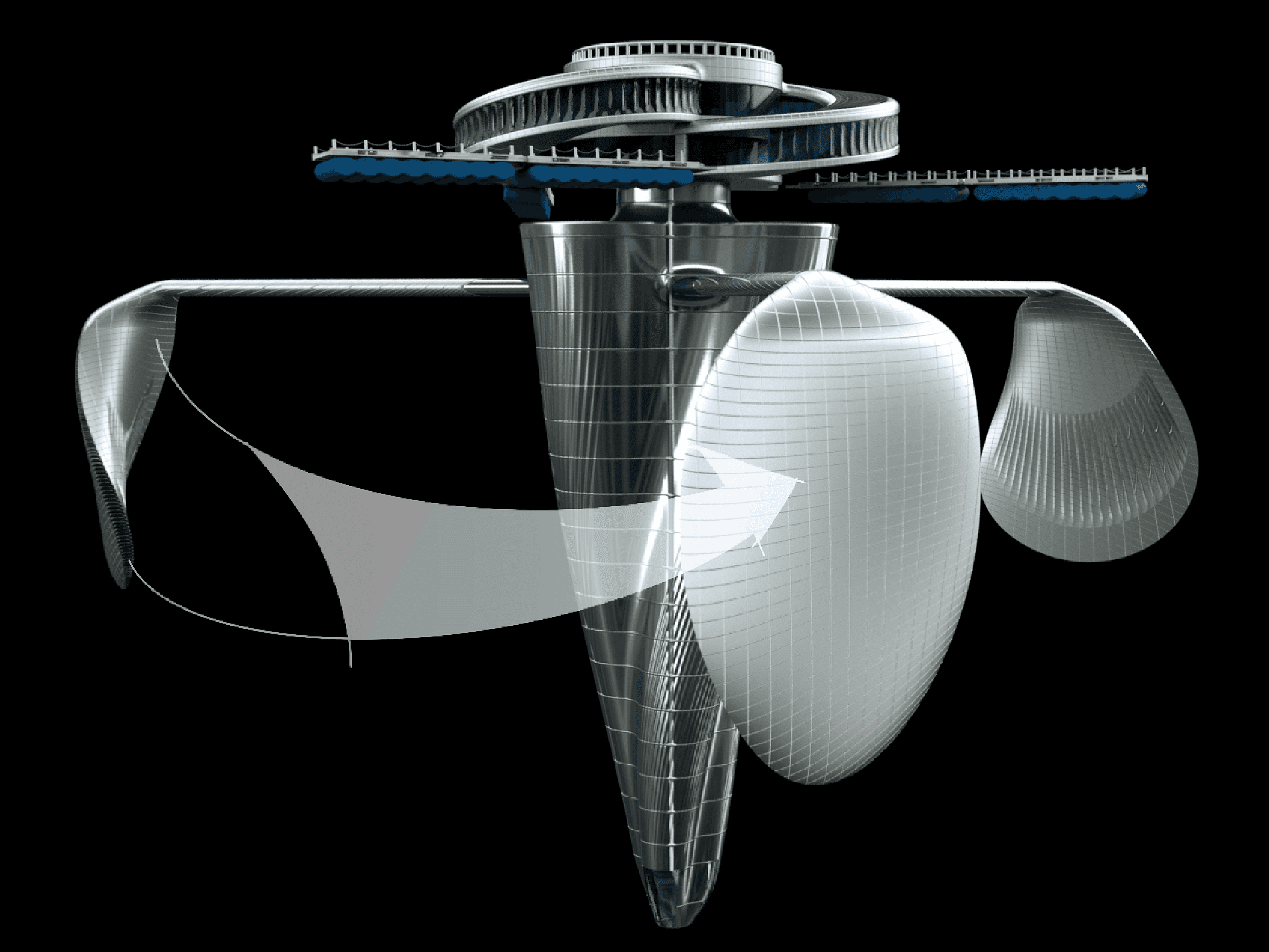
For stability in rough water, Thales relies on a deep, tapered underwater core that functions as a ballast-like spine to dampen pitching and rolling. Boarding is handled through a modular docking pontoon split into articulated segments, with a buoyant plate beneath the pontoon to absorb wave impact and reduce motion at the access interface.
The station operates with a hybrid renewable strategy combining wave energy capture, on-structure solar panels, and a rotary generation mechanism integrated into the lower body. These systems power desalination and onboard water purification through seawater intake and pressure-driven processes, alongside integrated ventilation and life-support infrastructure to enable extended stays.
Programmatically, Thales is zoned into secure research areas, controlled public routes, and functional growing/planting spaces to prevent interference with sensitive work. Visitors arrive by boat via the marina walkway or by air through the helipad, then follow guided circulation through designated viewing and learning zones, while scientists and operators access protected work areas and service paths—allowing research, visitation, and daily operations to run in parallel.
Together, these decisions frame Thales as an integrated platform—where offshore stability, energy and water autonomy, and program zoning work together to enable long-duration research, structured visitation, and everyday life at sea.
This project was recognized by the 2022 Shanghai Design 100+ Awards.
year
2020
timeframe
4 Months
tools
Rhino/Cinema 4D
category
Personal Project
01

02

03

04

05

06

07
08

09

010


